Imagine traveling back to 2006 and describing to someone how we do personal banking today. They’d have a hard time believing that banking and financial industries—typically plagued by traditional, outdated legacy processes—could ever offer more than the laborious processes they’re used to.
Fast forward to 2025, the age of app banking, tap-to-pay, and instant everything. You might assume customers have moved on from phone support, but they haven't. Forethought’s 2025 consumer survey found that nearly 60% of consumers still prefer to call when they need help from their bank. What's changed is their patience—they expect to be recognized, to get answers fast, and to not repeat themselves. That's a level of service that's hard to deliver with headcount alone.
The stakes are high. More than three-quarters of consumers say customer service quality heavily influences how they feel about a brand. With expectations rising and costs following, adding more agents isn't a sustainable path forward.
Financial Institutions are Graduating from Generative AI Chatbots to Agentic AI that Actually Resolves Customer Issues

In its early years, AI was used in financial services primarily for tasks like fraud detection and risk assessment. Today, in the new age of Agentic AI tools like Forethought, AI can not only speak with customers but actually resolve their issues to truly deflect work from your support team.
Agentic AI is different from the chatbots you've encountered before. Where earlier tools could answer questions or route customers to the right place, agentic AI actually resolves issues. It understands context, reasons through problems, takes action, and learns from each interaction to get better over time. For banks and other types of financial organizations, that means an AI that can check a balance, process a request, or surface the correct information without handing off to a human unless it's truly necessary.
Because of these benefits, the financial services industry is eager to adopt agentic AI in customer service operations. These businesses are confident that AI can fulfill—and exceed—customer expectations for real-time, personalized, and convenient service. In 2023, Ernst & Young reported that nearly all (99%) of the financial services leaders they surveyed reported that their organizations were deploying AI in some way, and all respondents said they are either already using, or planning to use, generative AI (GenAI) at their organization.
For companies already using agentic AI, the impact shows up where it matters most—in how many issues get resolved without adding headcount. According to Forethought's 2025 AI in CX Benchmark Report, companies using agentic AI report a 44% deflection rate, compared to 33% for non-agentic AI and 28% for companies not using AI at all.
Finance Customers Want Resolution, Not Conversation
When Forethought surveyed over 1,100 consumers in early 2025, nearly 60% preferred calling when they needed help from their bank. That's true across generations—even half of millennials said the same. At first glance, voice appears to be simply the channel customers prefer, but when you look more closely at why they like it, a different picture emerges.
58% believe a human agent is more likely to understand how they feel if they can explain it by talking instead of typing through a chat window. 53% said it's usually faster to speak with someone, and when asked what they want most from chat, the top answer was "connect me to a human agent."
Customers aren't loyal to voice. They've just learned that chat doesn't always resolve their issues immediately. Half of consumers have had to restart a chat session because they stepped away and the conversation timed out. Many more have watched a chatbot loop through the same unhelpful suggestions before finally offering to connect them with a person. The phone feels like the only channel where someone will actually understand the problem and fix it.
This is the gap agentic AI was built to close by delivering immediate understanding and real resolution without requiring a human on every interaction. When AI can actually resolve an issue, the pressure on your phone lines drops without the customer experience suffering.
Security Is Still the Barrier to AI Adoption in Banking
Agentic AI has the potential to transform how banks deliver customer service, but the technology isn't free of perceived risks. Security and data privacy remain top concerns. Issues like data confidentiality and the potential for discriminatory practices are real apprehensions that customers have about AI handling their financial information.
When Forethought surveyed consumers about AI using their personal data for the 2025 State of AI in CX Holiday Report, only 24% said they were comfortable with companies using their data outright. Another 38% said maybe, but only if it's limited to basic information. The remaining 38% refused entirely. Overall, 62% of consumers are open to AI using their data, but only under strict conditions.
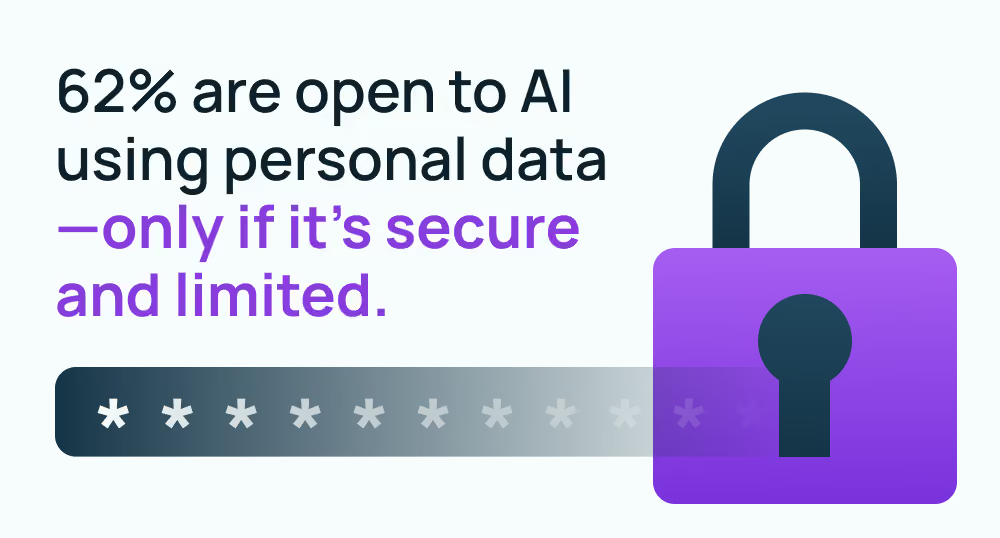
Trust isn't automatic, and for banks, that's the challenge: customers want the speed and convenience of AI, but not at the cost of their data.
Luckily, businesses can do a lot to mitigate those concerns. For example, businesses can follow best practices for data privacy and consumer safety, like the redaction of Personally Identifiable Information (PII), Protected Health Information (PHI), and financial records. This approach removes the privacy burden on businesses by aligning with the GDPR’s standards for data minimization and residency requirements and by eliminating the possibility of discriminatory practices from input data.
The Gap Between Customer Expectations and Staffing Will Only Widen
We went back in time to 2006 at the start of this article to paint a picture of how far financial technology has evolved. Now, imagine what the next 20 years will look like. Customer expectations are accelerating faster than your ability to hire, and the gap will only get wider.
Agentic AI closes that gap, not by replacing the human experience customers want, but by delivering it at scale. This technology will enable financial institutions to build stronger relationships, based on trust and loyalty, and stay competitive in a digital era that can move too fast—if you're not paying enough attention.
Hashtags blocks for sticky navbar (visible only for admin)
{{resource-cta}}
{{resource-cta-horizontal}}
{{authors-one-in-row}}
{{authors-two-in-row}}
{{download-the-report}}
{{cs-card}}