The holiday season has always meant long lines, crowded inboxes, and customer service teams running at full tilt. But this year, consumers are reaching out with less patience than ever before.
For CX leaders, that shift is more dangerous than increasing ticket volume, which is predictable. When people are under pressure during the holiday rush, the margin for error disappears. Bron Rasmussen, CX Operations at Cotopaxi, sees this play out every year.
“Our Q4 runs from November to January, and is still our busiest time,” says Rasmussen. “I am expecting to get overwhelmed with tickets this year. The combination of our small team, along with marketing promo shifts will create a lot of tickets. We’ll also just see lots of impatient customers who want exceptions to rules just based on the holiday season, and won’t take ‘no’ as an answer from our AI bot.”
Automation only creates value when it resolves cases quickly, with empathy, and with the ability to act directly on the customer’s behalf.
Customers are more impatient with customer service than last year
The pressure on customer service teams is increasingly about speed, in addition to volume. This year's data shows a notable shift in consumer tolerance: 57% of customers now refuse to wait longer than 10 minutes for service, up from 50% in 2024.
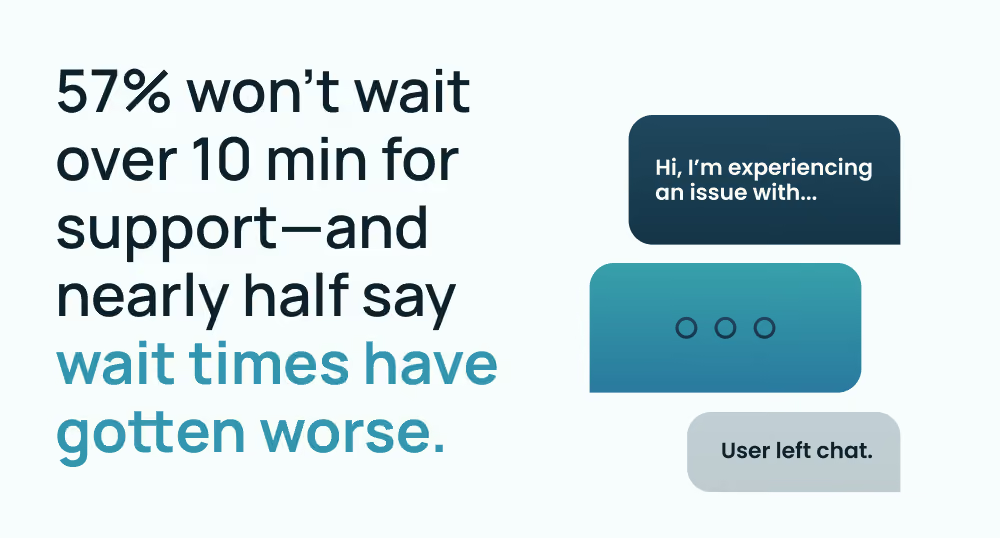
The most dramatic change is at the extreme end of the pool. Twenty percent of consumers won't wait more than five minutes before becoming frustrated, compared to just 14% last year. That's a significant erosion in patience, particularly for teams already stretched thin during peak season.
Interestingly, the perception of wait times hasn't changed as dramatically as the willingness to wait. Forty-seven percent of consumers feel wait times have increased compared to 43% in 2024, but the tolerance for those waits has contracted sharply. It's not that service has gotten markedly slower; it's that consumers have become markedly less patient.
"We see a combination of sentiments from customers in the holiday season," Rasmussen explains. "We have some that are super kind, patient, and understanding how busy this time of year is for everyone involved, but we also have some that seem to change their mindset to be more greedy. We expect the closer we get to those holidays, the more tensions will rise with delays and the idea of gifts not arriving in time."
There is one bright spot in the data: 72% of consumers say they're willing to extend their patience during the holidays and busy seasons. This suggests that consumers understand the realities of peak demand. They just need to see that companies are making an effort to resolve their issues efficiently. The challenge for CX teams is to meet the new 10-minute threshold and companies that can't meet it risk losing customers who simply won't wait around.
Customers are increasingly frustrated with automation loops
For all the investment in AI-powered customer service, the top frustration among consumers is still that automated systems fail to connect them to a human when needed. This was the number one complaint in 2024, and it remains the number one complaint in 2025.
What has shifted is the nature of the second and third most common pain points. Multiple handoffs between agents or departments now ranks as the second biggest frustration, swapping places with having to repeat information, which has dropped to third. Both issues point to the same underlying problem—automation for automation’s sake creates friction instead of removing it. That’s why it’s more important than ever to use agentic AI that resolves end-to-end.
Consumers aren't frustrated with AI itself. They're frustrated with AI that traps them in loops, forces them to explain their problem multiple times, or bounces them between departments without resolution. Other persistent complaints include limited support hours, being forced to call instead of resolving issues through their preferred channel, and simply taking too long to reach a resolution.
For Cotopaxi, avoiding these loops means designing automation with clear escape routes. "In all of our intents we have a fallback set that a consumer can opt to speak with our CX team if needed," Rasmussen explains. "Many of the messages we get are able to be deflected by our bot and get the consumer a resolution quickly, but there are always going to be tickets that just need a real human to help solve or talk the customer through."
The data suggests that the AI adoption wave of the past few years hasn't solved the fundamental problem. Companies have deployed more automation, but they haven't necessarily deployed better automation.
AI solves issues faster, but customers find non-agentic AI less helpful overall
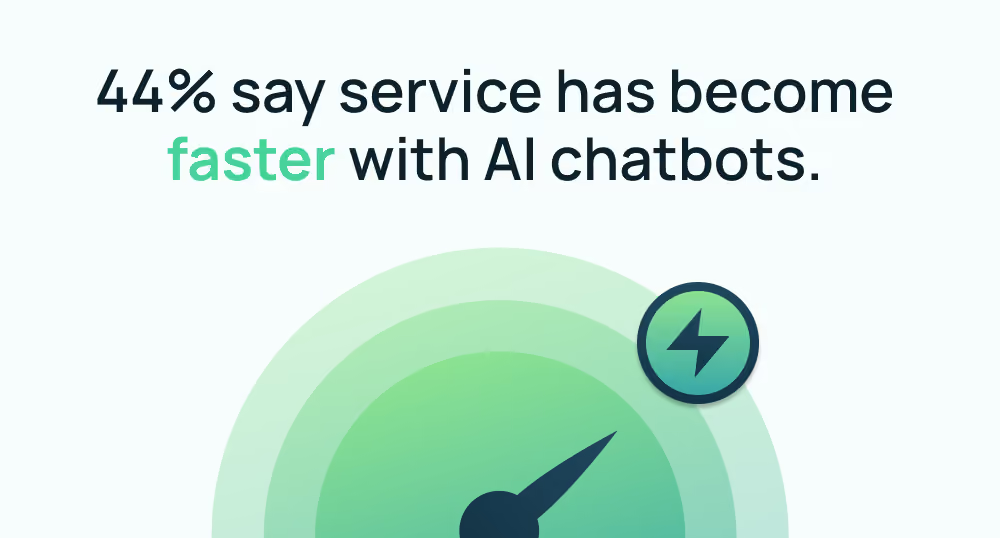
AI is winning the speed battle but losing the helpfulness war. Forty-four percent of consumers now say AI has made customer service faster, but while speed has improved, perceived helpfulness has actually declined. This year, 42% of consumers say AI has made service more helpful, down from 48% in 2024. More concerning, 42% now say AI has made service less helpful, up from 31% last year. For the first time, consumers are split evenly on whether AI is actually helping them or just processing them faster.
The gap between speed and helpfulness reveals a fundamental flaw in how many companies have deployed AI. Fast answers aren't valuable if they don't solve the problem. Consumers can tell the difference between an AI that quickly surfaces an FAQ and one that can actually resolve their issue by processing a return, modifying an order, or handling an exception.
This is where the distinction between traditional AI and agentic AI becomes critical. Generative AI may be able to deflect some simple, repetitive queries, by relaying information but deflection alone doesn't equal resolution. Agentic AI can take action on behalf of customers, handling tasks like processing refunds or applying promotions without requiring human intervention.
"It is great at eliminating the clutter within our inbox,” said Rasmussen. “The repeat tickets being taken out of the inbox allow our agents to focus time and attention on the tickets left that require help in the back end. AI also helps with promotions where you can outline a sale or promo and the bot can help customers reason through what is included and how it may work."
Until AI becomes truly agentic (capable of closing cases end-to-end rather than just answering questions quickly) the helpfulness gap will continue to widen, even as response times improve.
Generations differ on how human they want AI to feel
Consumers are getting better at detecting AI. More than half (55%) now say it's either very or extremely easy to tell when they're chatting with a bot rather than a human, up from 47% last year. But the more interesting finding is that different generations want completely different things.
Take pleasantries, for example. Sixty one percent of consumers prefer AI to skip the small talk and get straight to the point. Only 27% want AI to mirror human-style greetings and conversational warmth. But look at Gen Z, and the numbers flip: 41% want a human-like tone from their AI, compared to just 14% of Boomers. Younger consumers are nearly three times more likely to expect warmth and personality.
The same pattern shows up in how people talk to AI. Overall, 55% of consumers say they usually or always use "please" and "thank you" when interacting with bots. But Gen Z leads the politeness trend at 43%, while only 25% of Boomers bother with niceties.
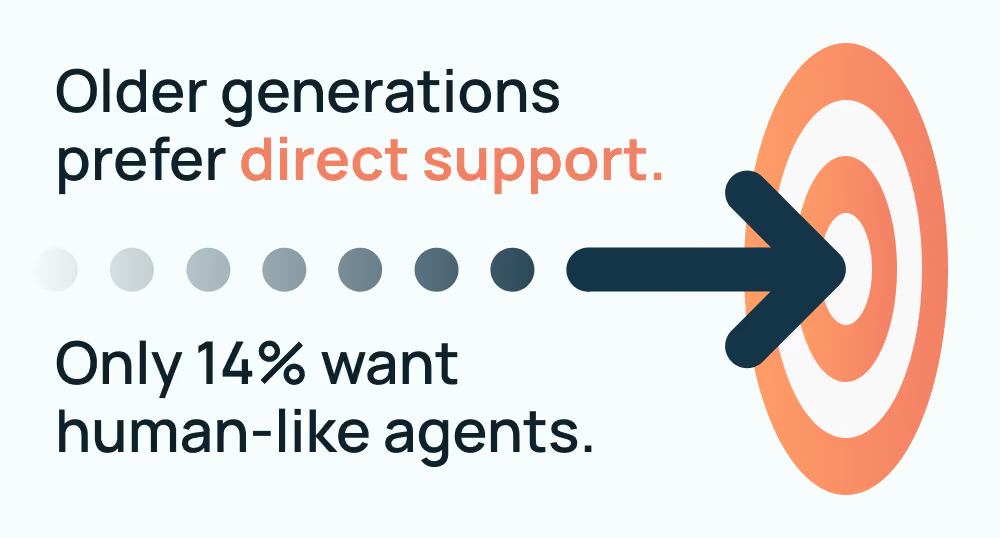
The generational divide becomes even sharper around personalization. When AI uses personal data to customize interactions, 46% of Boomers say they're annoyed, which is nearly twice the 24% of Gen Z who feel the same way. Younger consumers are more comfortable with AI that knows them and adapts; older consumers find it intrusive.
What this means for CX teams is that one-size-fits-all AI won't work. Younger customers want conversational, personalized interactions that feel less robotic. Older customers want efficiency without the pretense of a relationship they know isn't real. Still, every generation agrees on one thing: sometimes you just need a human. Rasmussen at Cotopaxi sees this play out constantly.
"In all of our intents we have a fallback set that a consumer can opt to speak with our CX team if needed," he explains. "Selling outdoor gear will also bring lots of technical questions that a bot is capable of answering, but are often better answered by someone with first-hand experience using the product in a real-world setting."
The solution is adaptive AI. Companies that can adjust tone and personalization based on customer signals will deliver better experiences across every demographic.
Consumers will share data with AI, but only if it earns their trust
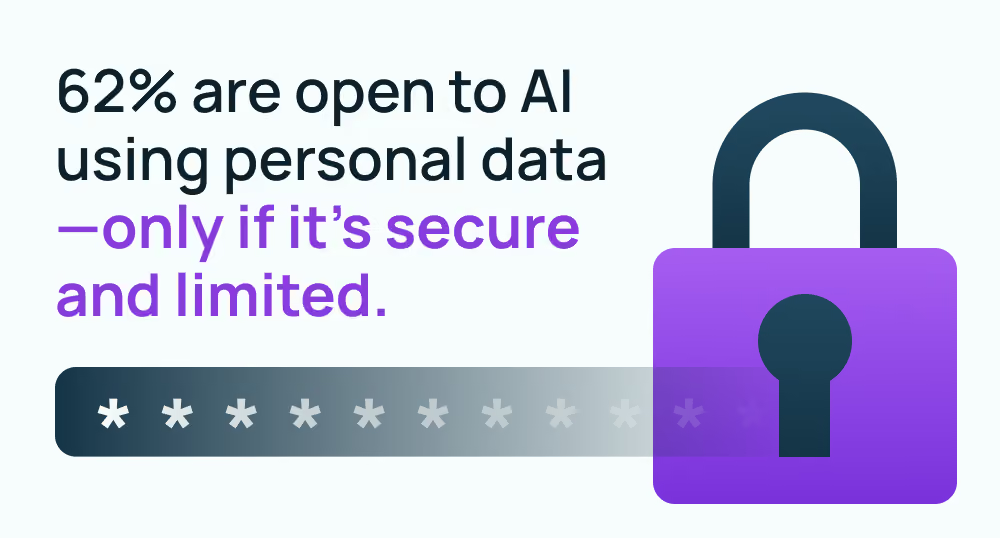
Trust remains the sticking point for AI adoption. When asked if they are comfortable with AI using their personal data to improve customer service, consumers are cautious but not entirely closed off. Only 24% say yes outright, provided the data is secure and private. Another 38% say maybe, but only if it's limited to basic information. The remaining 38% refuse entirely.
Overall, 62% of consumers are open to AI using their data, but only under strict conditions. Security and minimalism matter, and companies that ask for too much, or fail to demonstrate how they're protecting customer information, will lose trust before they gain efficiency.
For many businesses, the good news is that effective AI doesn't require deep personalization to deliver value. At Cotopaxi, seasonal policy changes are handled with straightforward automation.
"We only change our return window to allow returns to extend from October to January," Rasmussen explains. "It's a simple intent change to inform customers of this extension. Not much AI intervention is needed for us on this one."
This approach highlights that AI doesn't need to know everything about a customer to be useful. Simple, transparent use cases, like surfacing updated return policies or answering common questions, can improve the customer experience without crossing privacy boundaries.
The challenge for CX leaders is to balance personalization with privacy. Consumers are willing to share data if it makes their experience genuinely better and if they trust the company to handle it responsibly. But that trust has to be earned with transparency, minimal data collection, and clear security practices.
The AI consumers are demanding is agentic
Last year, the conversation was about AI adoption rising while RAG-based solutions fell short of expectations. This year, we’ve found that the first wave of AI adoption, powered largely by generative models that answer questions but can't take action, has hit its ceiling.
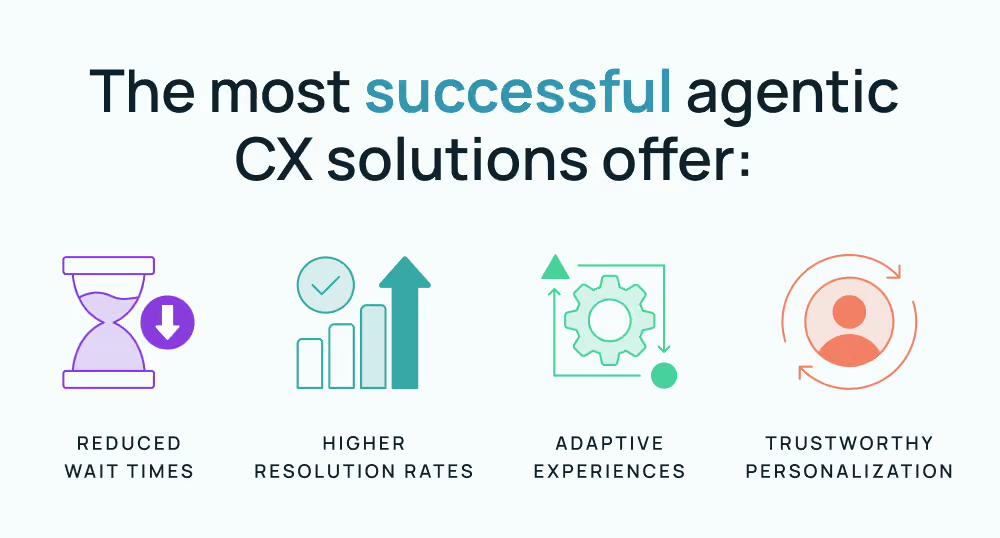
Consumers want AI that's helpful, not just fast. They want automation that solves problems, not creates new ones. The businesses that will succeed during this holiday season and beyond are those that move beyond deflection and embrace agentic AI. Only agentic AI can truly reduce wait times through intelligent automation and triage, increase resolution rates by focusing on helpfulness rather than speed alone, adapt to different demographics with the right tone and personalization, and build trust through secure, transparent data handling.
The window for upgrading is closing and consumers won't wait around—literally or figuratively—for companies to catch up.
Methodology
Results are from an online survey of 1,000+ U.S. adults aged 18 and up, fielded in September 2025. The data was weighted to the U.S. population by demographic variables. Year-over-year comparisons reference two 2025 surveys: one of 1,091 adults fielded September 20-23, 2025, and one of 1,136 adults fielded October 4-7, 2025. The credibility interval for questions answered by all respondents is ±4 percentage points.
Hashtags blocks for sticky navbar (visible only for admin)
{{resource-cta}}
{{resource-cta-horizontal}}
{{authors-one-in-row}}

{{authors-two-in-row}}
{{download-the-report}}
{{cs-card}}