When AI customer service platforms surged into the mainstream, the initial metrics were exciting: fast response times, quick deflections, and instant relief for overburdened support queues.
Then, for many CX teams, the trajectory flattened.
Deflection rates stagnated. CSAT scores hit a glass ceiling. Customers found workarounds to reach human agents, and support teams found themselves managing an automated tool rather than scaling their business.
If your AI support initiative feels stuck on a plateau, the technology itself isn't necessarily the bottleneck. The root cause usually traces back to three strategic missteps—and a fundamental misconception about what current AI models are designed to do.
1. You’re Using Rigid, Legacy AI Instead of Self-Learning Agentic AI
Many customer service programs hit a wall because they are built on legacy, decision-tree architecture disguised as "AI." Traditional chatbots rely on pre-programmed decision logic: If the user says X, show response Y.
When a query strays slightly off-script, legacy bots break. They fail to reason through a problem, leaving customers stuck in loop-of-death responses.
To break through the plateau, support teams must transition to self-learning, Agentic AI. Unlike static decision engines, agentic AI operates with reasoning capabilities:
- Autonomous Action: It doesn't just surface a help center link; it executes actions within your CRM or backend systems (e.g., initiating a refund, updating a shipping address, or authenticating an account) based on business policy.
- Continuous Improvement: Agentic systems analyze past successful ticket resolutions and customer outcomes to refine their responses automatically over time.
If your AI system isn't learning from real-world resolutions, its performance ceiling is locked on day one.
2. The Context Disconnect: Treating Every Interaction in Isolation
Nothing frustrates a customer faster than repeating themselves. Yet, a primary driver of the AI plateau is treating customer interactions as isolated events rather than an ongoing conversation.
When an AI tool lacks deep context across systems and channels, it operates with severe amnesia.
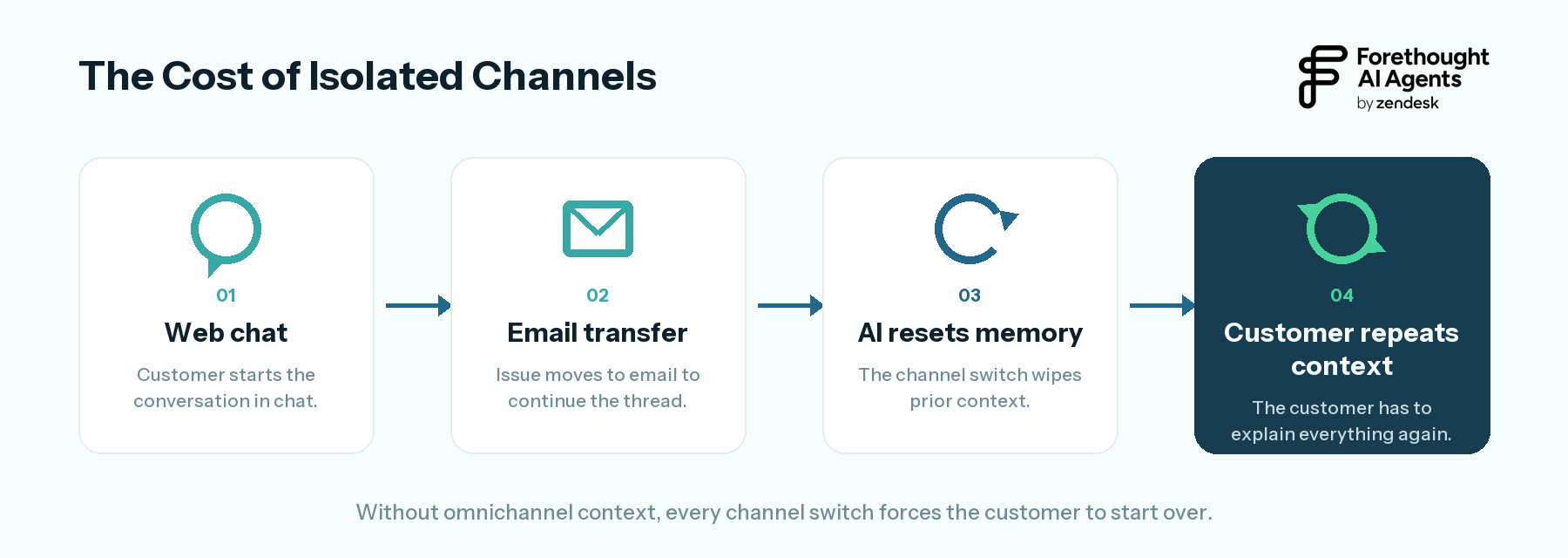
Unlocking higher-tier automation requires deep integration across your entire helpdesk and CRM stack. Modern AI must possess:
- Cross-Channel Memory: Recognizing that the email sent today is a continuation of the chat from yesterday.
- System-Wide Context: Understanding the customer's lifetime value, recent order history, account tier, and past tickets before generating a single word.
- Sentiment and Intent Awareness: Detecting frustration or urgency and adapting tone—or routing the case instantly to a specialized human agent with full context intact.
Context turns generic, transactional bots into hyper-personalized, high-CSAT support partners.
3. The "Set It and Forget It" Trap: CX Teams Aren't Investing in AI Management
Perhaps the single biggest reason AI programs plateau is operational neglect. AI is often bought as a tool, but it needs to be managed like a team member.
Deploying an AI agent without ongoing management is like hiring a human support rep, putting them through one hour of onboarding, and never checking their work again.
High-performing CX teams don't just "set and forget" AI. They build an internal operational cadence around it:
- Dedicated AI Quality Assurance (QA): Regularly reviewing AI-resolved tickets to check for accuracy, tone, and compliance.
- Intent & Workflow Optimization: Analyzing drop-off points, identifying unhandled edge cases, and building out new workflows for complex intents.
- Knowledge Base Hygiene: Feeding the AI clean, structured, and updated documentation. If your internal documentation is outdated, your AI's outputs will reflect those errors.
How to Break Through the Plateau
Moving past the AI plateau doesn't require scrapping your automation strategy; it requires elevating it from passive deflection to proactive resolution.

If your AI performance has flattened, shift focus from deflecting tickets to empowering an intelligent agentic ecosystem. Treat your AI like your top-performing employee: feed it the right context, pair it with modern architecture, and continuously refine its skills. That is how you transform customer service from a cost center into a competitive advantage.
Hashtags blocks for sticky navbar (visible only for admin)
{{resource-cta}}
{{resource-cta-horizontal}}
{{authors-one-in-row}}

{{authors-two-in-row}}
{{download-the-report}}
{{cs-card}}