For the past two years, the AI race has been about one question: who could build the assistant that knew every answer?
It made sense. Businesses needed proof AI could answer customer questions, automate repetitive work, and resolve increasingly complex requests. The first generation of AI delivered exactly that, transforming customer service in the process. AI assistants are now helping teams summarize conversations, draft responses, automate repetitive work, and resolve more customer issues than ever before.
But as AI becomes embedded into everyday service operations, the conversation is beginning to change. The challenge is no longer building one AI assistant that knows every answer. It's building specialized AI agents that know exactly where they create the most value. The next race in AI won't be about broader capability. It'll be about deeper specialization.
Great service has always relied on specialists
Service leaders already understand why specialization matters. The best service teams never expected one person to do everything. A billing expert handled payment disputes. A technical specialist solved complex product issues. A customer success manager stepped in when relationships mattered most.
Until now, AI has largely taken a different approach. The ambition has been to build one assistant capable of supporting every interaction. That made sense while the industry was proving what AI could do, but as Shashi Upadhyay, President of Product, Engineering and AI at Zendesk, explains, "AI agents can act but too often they don't coordinate. They do one step. But the next step still starts at zero."
That's the limitation of general-purpose AI. Customer service isn't a collection of isolated tasks. It's a connected system of people, workflows, and customer journeys. Solving one step well isn't enough if the next interaction loses context and starts from scratch.
And customers don't care who's solving the problem. They care that the right expertise appears when they need it and that the experience feels effortless from beginning to end.
The rise of the AI specialist
Rather than relying on one assistant to support every interaction, businesses will increasingly deploy specialist AI agents designed for different parts of the business. Some will specialize in technical support. Others will focus on employee service, finance, healthcare, or commerce. Each will develop deeper expertise because it is grounded in the knowledge, workflows, policies, and context unique to the work it is designed to do.
This is more than a shift in what AI can do. It is a shift in what a workforce can be.
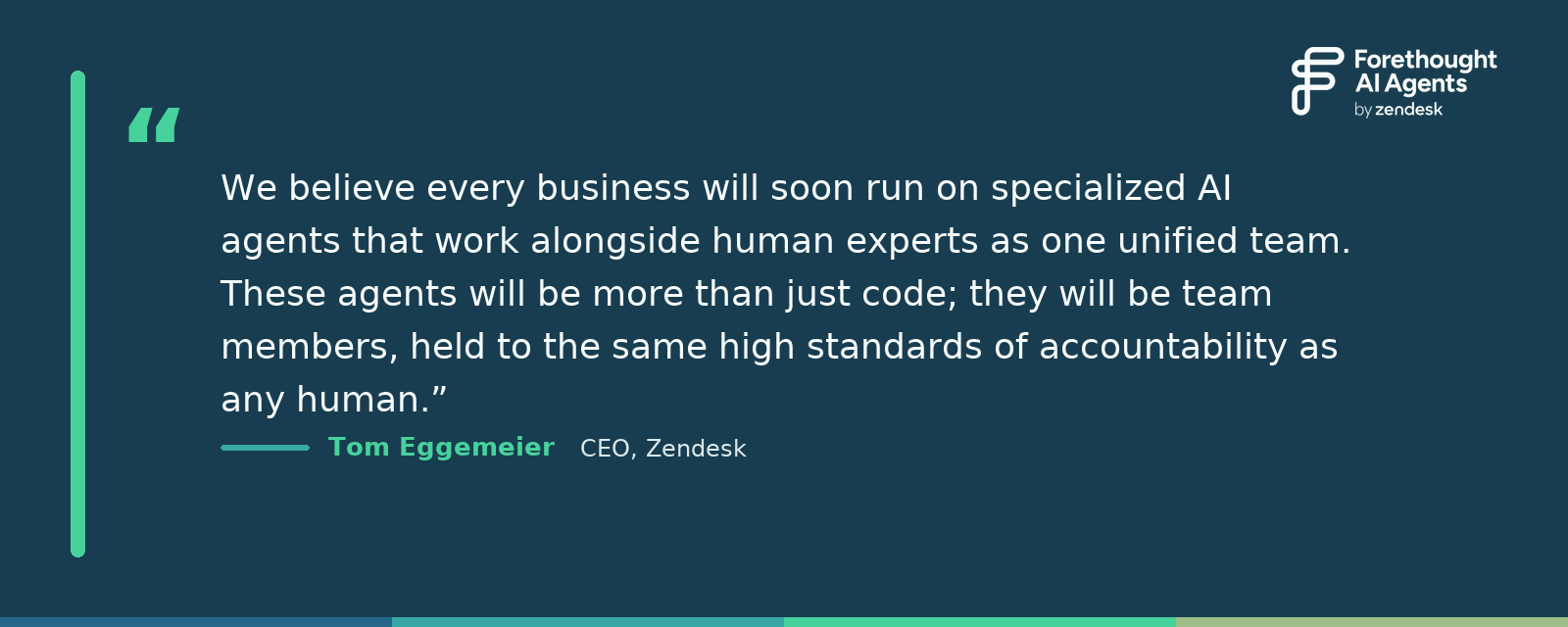
The implication for service leaders is clear. The challenge will not be choosing between human and AI support. It will be designing how different kinds of expertise work together across the customer journey.
That is why these specialists cannot operate in isolation. The next generation of AI will coordinate across other agents, business systems, and human experts to move work forward without losing context along the way. The customer may never see that coordination, but they will feel the difference in every interaction.
Service teams will blend people and AI, while still feeling coherent, accountable, and personable to the customer.
Ecommerce is showing us what specialization looks like
Ecommerce is one of the first places where this shift is becoming visible. Customers don't think in pre-purchase and post-purchase interactions. They think about shopping. A single conversation can begin with discovering the right product, continue through checkout, move into delivery updates, and finish weeks later with a return or exchange.
Many AI experiences still divide that journey across separate assistants. One bot helps customers shop. Another takes over after purchase. Each has its own memory, creating unnecessary handoffs and forcing customers to repeat themselves every time the conversation changes.
Specialist AI takes a different approach. Zendesk's eCommerce AI Agent is purpose-built for commerce. Rather than specializing in one stage of the shopper journey, it specializes in the journey itself. It understands products, orders, fulfillment, shipping, returns, and exchanges as one connected experience. It recognizes returning shoppers, carries context across every interaction, and grounds every response in customer history, order information, live product data, and service knowledge so every conversation begins where the last one ended.
The expertise doesn't stop there. Every resolved conversation strengthens the next, operating through Zendesk's Resolution Learning Loop where each interaction becomes a signal that’s fed into the platform’s improvement engine. Insights are captured to help agents optimize future responses, identify opportunities to strengthen knowledge and workflows, and continuously refine how work gets done. Rather than relying on static rules, the Zendesk AI Agents become more capable with every customer interaction.
Commerce won't be the last place this happens. It's simply one of the first industries showing us what specialist AI looks like in practice.
Orchestrating AI starts to look a lot like coordinating people
As specialist AI agents become part of everyday service delivery, the role of service leaders begins to change. The challenge is no longer deciding whether AI belongs in customer service. It's deciding how expertise should be organized across people and AI.
Which requests are best handled by a commerce specialist? When should a technical specialist step in? Where does human judgment create the greatest value? How should work move between specialists without disrupting the customer experience? These are questions service leaders have always answered when managing people. Increasingly, they'll answer them for AI too.
That's why the future of service won't be defined by one brilliant AI assistant. It will be defined by teams of specialists—human and AI—working together toward the same customer outcome. We call these teams the autonomous workforce, a coordinated network of specialist AI agents and human experts designed to resolve work end to end.
Hashtags blocks for sticky navbar (visible only for admin)
{{resource-cta}}
{{resource-cta-horizontal}}
{{authors-one-in-row}}

{{authors-two-in-row}}
{{download-the-report}}
{{cs-card}}