Nearly 40% of customer support work is still eaten up by repetitive, low-complexity tasks. Despite years of heavy investment in AI, frontline agents remain bogged down by fragmented systems, missing context, and endless manual workarounds.
This finding lies at the heart of our 2026 State of AI in CX Report. The underlying lesson is clear: AI adoption is now table stakes.
In 2024, the primary question for CX teams was "Should we deploy AI?" By 2025, it became "Where can we plug AI in?"
Today, simply having AI in your tech stack offers zero competitive advantage. The market has split between companies that merely deployed an AI tool and leaders building systems that act, adapt, and drive measurable return on investment.
The AI Maturity Shift: Answering, Acting, and Improving
To understand why some teams eliminate repetitive work while others stay stuck, our report tracks how customer service operations evolve across three distinct phases of AI maturity:
1. The Answering Phase: FAQ & Assistive Bots
Basic bots answer questions, deflect simple volume, and pull static information. While useful for immediate triage, answer-only AI reaches a hard performance plateau. It cannot resolve multi-step workflows, handle complex logic, or eliminate the underlying causes of agent burnout.
2. The Acting Phase: Agentic & Action-Taking Systems
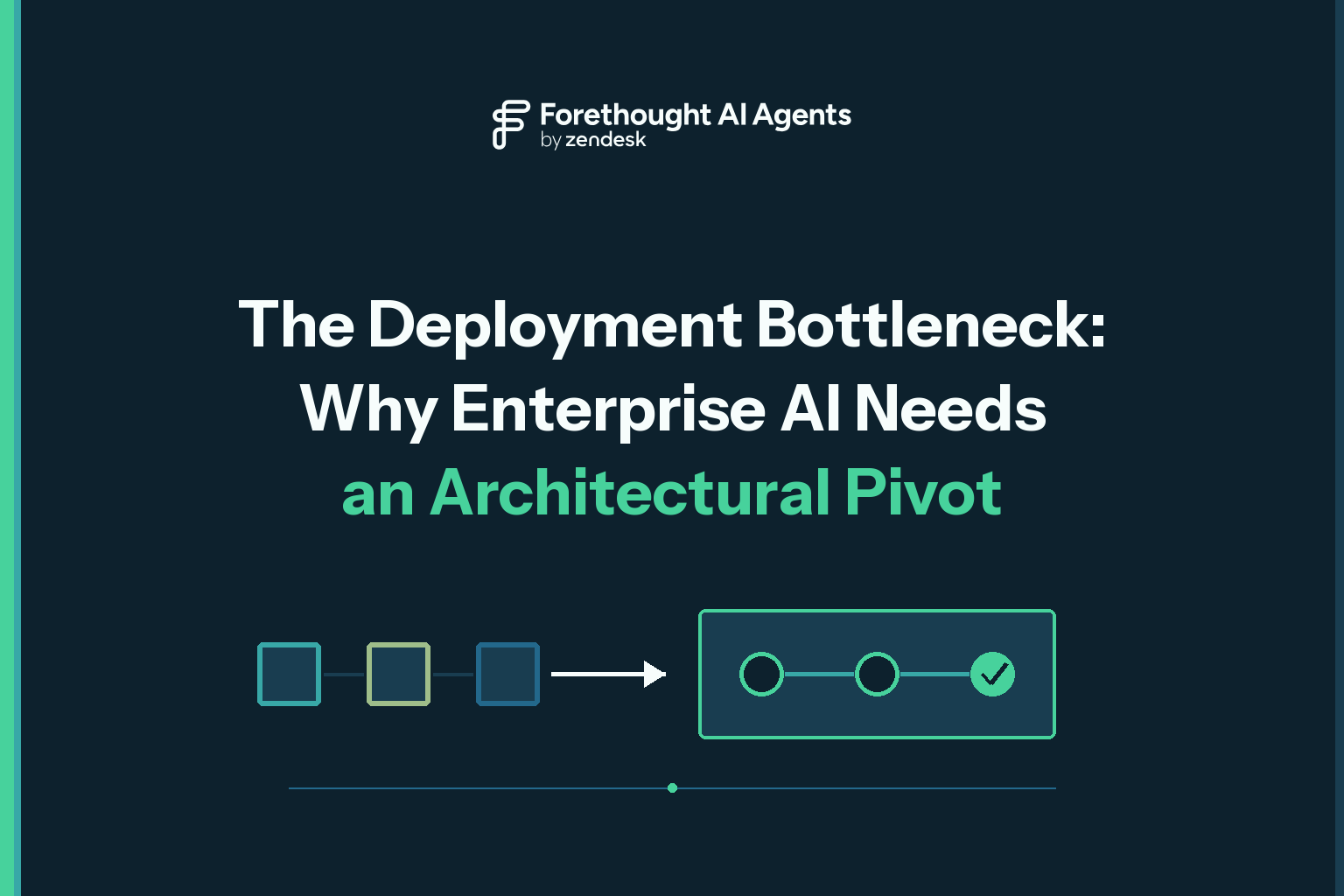
The real difference is seen when AI transitions from answering questions to executing tasks. Action-taking systems execute full end-to-end workflows—processing refunds, updating accounts, verifying identities, and navigating background systems across email, chat, and voice. Organizations utilizing agentic workflows show dramatic gains in First Contact Resolution (FCR) compared to those relying on surface-level Q&A.
3. The Improving Phase: Autonomous Learning Loops
The top tier of CX performance belongs to self-improving platforms. These architectures ingest service history data, preserve context across every touchpoint, and feed automated quality assurance (QA) data back into the system to refine responses automatically.
"AI success is no longer measured by whether you’ve deployed AI, but by whether the system keeps improving autonomously."
— Aakash Kumar, Director of AI Customer Success
What the Data Teaches Us About CX Architecture
To move up this maturity ladder, CX leaders must focus on two core operational insights revealed in the report:
Architecture determines whether AI can progress beyond answering
Not all tech stacks support high-level automation. Standard helpdesk add-ons and internal DIY builds frequently hit scalability walls—either falling short on deep workflow execution or creating heavy ongoing maintenance burdens. To achieve lasting performance, the underlying architecture must support real-time data integration, complex logic processing, and flexible system orchestration.
Real-world impact demands proved execution
The performance gap between passive bots and active systems is reflected in real business operations. When AI moves from answering queries to executing multi-step workflows without adding administrative burden, support teams scale efficiently while improving overall service quality.
"By automating repetitive, low-complexity inquiries with agentic AI, our team maintains high service quality and faster resolution times—scaling our operational footprint without having to scale headcount proportionally."
— Jessie Roberts, CX Operations Lead at Clair
3 Strategic Actions for CX Leaders
Translating these benchmark insights into operational success requires moving beyond passive software rollouts. Top-performing CX organizations focus on three core practices:
- Optimize for complete resolutions, not just deflections: Shift primary success metrics from basic deflect rates to end-to-end workflow completion and resolution accuracy.
- Connect AI to historical data and channel context: Eliminate repetitive customer explanations by ensuring your AI engine ingests full interaction histories across every channel.
- Build continuous QA feedback loops: Treat AI management as an ongoing refinement process, using performance analytics and quality scores to continuously tune the system.
Raising the Baseline for CX Performance
Deploying AI is no longer a differentiator—it is the baseline requirement for modern customer service. The real competitive advantage in 2026 belongs to organizations that treat adoption as the starting line, building resilient systems that execute complete tasks, learn from every interaction, and autonomously raise the standard of customer experience.
Hashtags blocks for sticky navbar (visible only for admin)
{{resource-cta}}
{{resource-cta-horizontal}}
{{authors-one-in-row}}

{{authors-two-in-row}}
{{download-the-report}}
{{cs-card}}