Retail has always run on speed. Customers expect answers immediately when they ask, and during peak seasons, the volume of questions can overwhelm even well-staffed teams.
Many companies responded to this pressure by deploying automation, and on the surface, it worked. Response times dropped, chatbots picked up the slack, and the dashboards finally started telling a better story. But something else happened—customers reported that the service felt faster yet less helpful. The AI answered their questions quickly and then left them to determine the next step.
Forethought's 2025 research, based on interviews with more than 1,000 consumers and 600 CX leaders, shows how retail companies like Cotopaxi are winning with AI. What separates retailers who are winning with AI from those who deployed automation and saw nothing improve comes down to AI that can take action.
Their Automation Strategy Keeps the New Patience Threshold in Mind
Holiday seasons have always meant higher volume, but what's changed between 2024 and 2025 is tolerance for any wait time. According to our 2025 State of AI in CX Holiday Report, 57% of consumers now refuse to wait more than 10 minutes for service, up from 50% last year. At the extreme end, 20% give up at five minutes, compared with 14% the previous year.
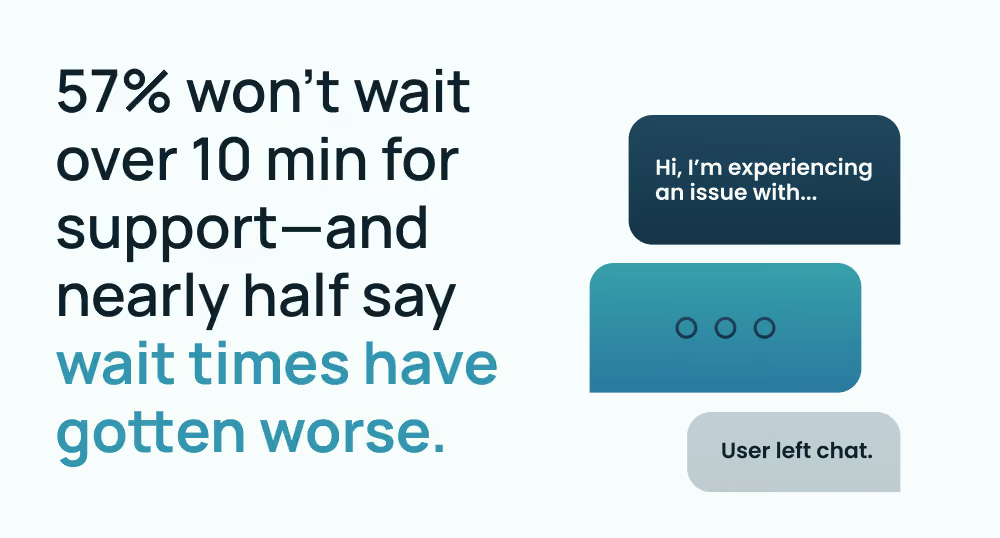
But there is a bright spot in the data. 72% of consumers say they're willing to extend their patience during busy seasons if they see companies making an effort to resolve their issues. Customers understand peak demand; they just need to see that you're trying.
"Our Q4 runs from November to January, and is still our busiest time," says Bron Rasmussen, CX Operations at Cotopaxi. "I am expecting to get overwhelmed with tickets this year. The combination of our small team, along with marketing promo shifts will create a lot of tickets."
Since customers measure effort by resolution, the metric that matters most is resolution time. While other metrics like response time will shift dramatically, a fast reply followed by a 20-minute wait to actually finish still counts as a loss. If your average resolution exceeds 10 minutes, you're bleeding goodwill at scale, and most customers will leave before they complain.
Start by identifying which ticket types take the longest to resolve and prioritize automating those first. Cotopaxi kept headcount steady through the holiday season despite company growth by focusing its AI on the volume drivers. The target worth aiming for is 80% of common issues resolved in under five minutes without human involvement because that’s the threshold where speed starts to feel like service.
They Regularly Audit Their Automation for False Deflection
That same holiday report found that the top three consumer frustrations with customer service stayed the same from 2024 to 2025:
- First, automated systems that fail to connect them to a human when needed.
- Second, multiple handoffs between agents or departments.
- Third, having to repeat information.
The pattern points to false deflection. While you might have a dashboard that shows a ticket was handled, but it’s also true that the same customer came back a day later through a different channel with the same issue. You may have been able to automate the answer to a question, but the customer still had to take the next step themselves, so they gave up, switched channels, or tried again later.
Our 2025 Benchmark Report surveyed 642 CX professional across the US and found how much false deflection hides in the numbers. Companies using AI that can complete tasks reported a 44% deflection rate. Companies using AI that can only answer questions reported 33%. That 11-point gap represents tickets that got marked as handled while the customer's issue stayed open.
"It is great at eliminating the clutter within our inbox," says Rasmussen. "The repeat tickets being taken out of the inbox allow our agents to focus time and attention on the tickets left that require help in the back end."
The clutter reduction Rasmussen describes only works when the AI actually resolves those tickets. To see how well you’re truly resolving issues, try pulling a sample of deflected tickets and trace whether those customers returned within 48 hours with the same issue. If your deflection looks high but your overall ticket volume stays flat, you have false deflection. Cotopaxi, for example, uses chat insights in Forethought to monitor topics, which surfaces patterns and gaps before they compound.
They Deploy AI That Takes Action
Most retail tickets are transactional. Issues like asking about order status, return initiation, promo codes, and address changes have clear steps and fixed rules, which makes them ideal for automation. As you’ve probably discerned by now, the problem is that most AI can only answer questions about these transactions. It can explain your return policy, but the customer must still initiate the return.
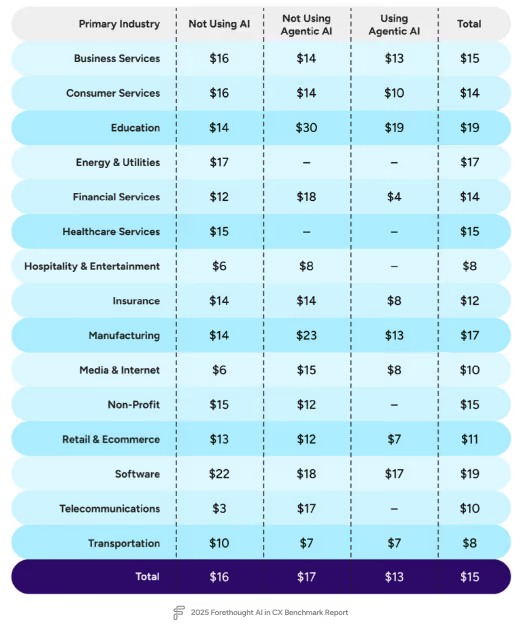
Our 2025 Benchmark Report findings show that retail companies pay for this limitation. When retail and e-commerce companies work with agentic AI, such as Forethought, they average $7 per resolution, compared with $12 for AI that only answers questions. That's nearly half the cost, and the difference comes down to whether the transaction actually finishes.
Forethought's agentic AI resolves issues across chat, email, and voice through a single reasoning engine called Autoflows. When a customer requests a return through chat, the AI verifies the order, checks eligibility, and processes the return. When the same customer follows up by email, the context carries over. The AI can complete the same types of transactions across channels because the same intelligence powers all three.
"[Agentic] AI also helps with promotions where you can outline a sale or promo and the bot can help customers reason through what is included and how it may work," says Rasmussen. At Cotopaxi, the AI doesn't just explain a promotion. It helps the customer apply it.
Cotopaxi, for example, integrated with Kustomer and Shopify, which gave the AI access to customer and order data. That connection lets the AI verify, act, and confirm within a single interaction. To apply this, list your top 10 ticket types by volume and ask whether each requires information or action.
They Cater to Different Support Preferences Across Generations
Different generations want fundamentally different things from AI interactions, and retail customers span all of them. According to our Holiday Report, 61% of consumers prefer AI to skip pleasantries and get to the point, but Gen Z flips that preference. 41% of younger consumers want warmth and personality from AI, compared with just 14% of Boomers. The same split shows up in personalization. 46% of Boomers are annoyed when AI uses personal data to customize interactions. Only 24% of Gen Z feel the same way.
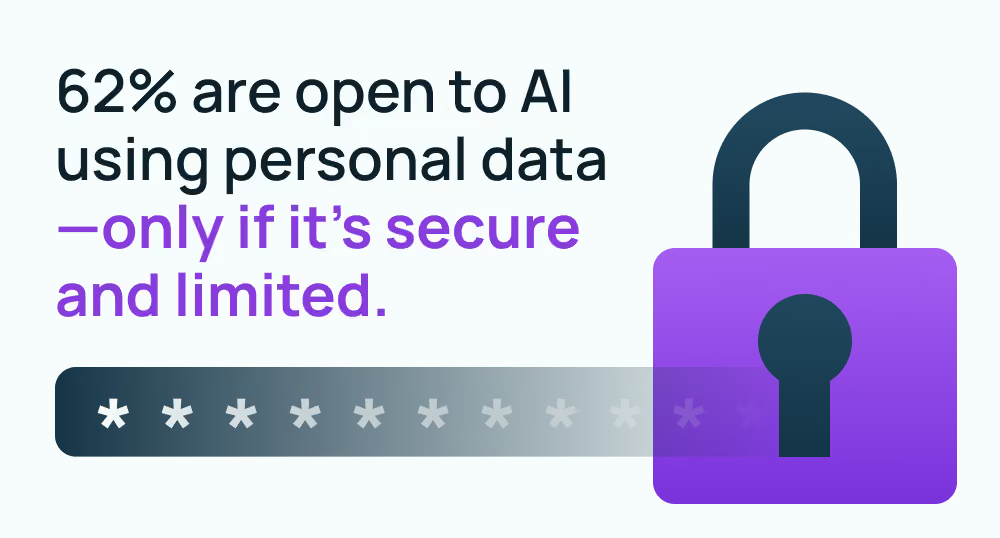
If you design for efficiency, you frustrate younger customers who expect personality. If you design for warmth, you frustrate older customers who find it intrusive. Either way, a single approach leaves a significant portion of your customers dissatisfied. The solution is AI that adapts based on what the customer needs.
"When implementing Forethought—going from our old chatbot to the new one—the biggest thing was the ability to route customer questions automatically through specific intents," says Alexia Bench, Consumer Insights Manager at Cotopaxi. "We didn't have to force customers to pick specific categories. That just made things so much easier to build."
Intent-based routing allows AI to respond to what the customer is actually asking rather than funneling them into a predetermined path. If your platform allows tone adjustment, test variations for different ticket types: direct and efficient for transactional queries, warmer for complaints or complex issues.
A Deeper Look at How Cotopaxi Has Successfully Automated Support
Cotopaxi faced the challenge this approach is designed for: a small CX team heading into Q4, company growth outpacing headcount, and a 4.5 CSAT score they refused to sacrifice.
They needed to increase deflection without letting service quality slip, which meant they needed clear control over when AI engages and what it says, deep reporting to monitor conversations and intent flows, and integration with Kustomer and Shopify so the AI could actually complete transactions.
Before going live, Cotopaxi ran a Proof of Concept (POC). They refused to trade service quality for automation numbers, and they committed to treating their knowledge base as a living system rather than something to set up once and forget.
They deployed Forethought for chat with defined customer intents and no forced categories, which allows the AI to route based on what each customer is actually asking. Then they integrated with Kustomer and Shopify so the AI has access to customer and order data, which lets it verify, act, and confirm within a single interaction. They use Forethought's insights to identify missing articles, and during the holiday rush, Discover generates ready-to-edit templates so their team can fill gaps quickly.
In the first six months of 2024, Cotopaxi saved $76,000 and increased its deflection rate by 28% while maintaining its 4.5 CSAT. They kept headcount steady through the holiday season despite company growth. One team member manages knowledge base audits and updates.
In Retail, Speed is Meaningless Without Resolution
Consumer patience is shrinking every year, and most automation has only made things faster without making them better. The retailers winning right now designed for resolution time, audited for false deflection, deployed AI that takes action, gave customers flexibility based on what they actually need, and built human escalation into every workflow from the start.
The question for your team is whether your AI can actually finish the job. Request a demo to see how Forethought helps retail companies resolve issues end-to-end.
Hashtags blocks for sticky navbar (visible only for admin)
{{resource-cta}}
{{resource-cta-horizontal}}
{{authors-one-in-row}}

{{authors-two-in-row}}
{{download-the-report}}
{{cs-card}}