Customers don't interact with your business in one place. They move across channels, systems, and moments and every one of those moments generates signals. Whether that be product usage, billing events, or support interactions. The data is there.
The problem is that most systems can't act on it in real time.
Most companies have individual components like AI that can answer questions, workflows that automate steps, backend systems that trigger events, but those rarely work well together. AI can respond, but it can only respond. It waits for a customer to reach out, handles the interaction, and stops there. Meanwhile, signals are firing across your business billing changes, product events, at-risk behavior—and nothing connects them to action. Teams are left bridging that gap manually and stitching together context that should be flowing automatically.
That's the gap we built Orchestrator to close.
What Orchestrator Does
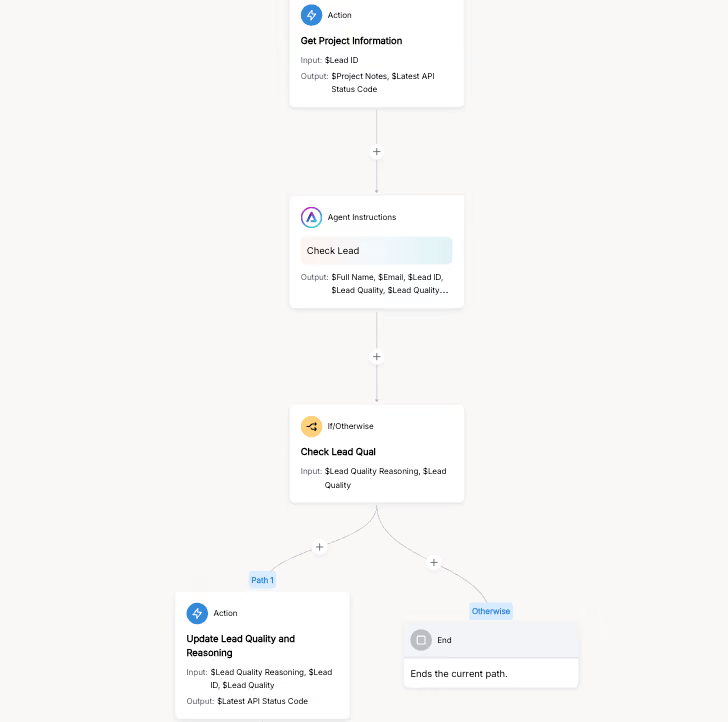
Orchestrator connects triggers, business logic, AI agents, and system actions into a single workflow so teams can coordinate what happens across channels and systems in real time.
Instead of thinking about automation as isolated steps trapped inside individual tools, Orchestrator turns the customer journey into a coordinated system of actions.
From Signals to Outcomes
Every orchestration starts with a signal.
That could be:
- An API call from a backend system
- A product or billing event
- A scheduled condition
- A customer interaction
Orchestrator also expands this to include third-party signals, like website events or external triggers, allowing teams to proactively initiate journeys instead of waiting for customer outreach.
This is how teams begin to truly act on every customer moment.
Deterministic Control Over AI
One of the biggest challenges with AI is control.
Teams need to ensure that automation follows business rules, not just probabilities.
With Orchestrator, teams can define:
- Conditional logic and branching paths
- Timing rules and delays
- When AI agents should or should not act
- What actions should be executed
This ensures that AI operates within clear constraints and produces predictable outcomes at scale.

Experiences Span Everything
Customer experiences don't happen in one channel. They span chat, voice, email, backend systems, CRM, and billing platforms. Today, most companies rebuild workflows for each one. That's brittle and expensive.
Orchestrator lets teams define logic once and apply it everywhere, ensuring a consistent experience across every touchpoint without duplicating work.
What This Looks Like in Practice
We're already seeing this play out with our customers. Two examples from Orchestrator in production:
Proactive outreach from external events: A billing system sends a failed payment event. Orchestrator evaluates account priority, applies business rules, and triggers an outbound voice call. The result is faster recovery and reduced churn — without a human triaging the event.
Proactive information gathering: A customer submits a support ticket, but it's missing key details needed to resolve the issue. Orchestrator detects the gap, evaluates what's missing, and automatically reaches out to the customer to collect the details before an agent ever picks up the ticket. The result is faster resolution times and fewer back-and-forth cycles for both the customer and the support team.
These aren't hypotheticals. This is how teams are turning signals into outcomes right now.
The Bigger Picture
At Forethought, a core focus this year is helping teams deliver on every customer moment. That means moving beyond isolated interactions toward experiences that start from real-time signals, span channels and systems, adapt based on context, and drive measurable business outcomes.
Orchestrator is a foundational step in making that possible. But the real opportunity isn't just in generating responses—it's in coordinating systems, actions, and workflows so every interaction moves the experience forward.
We're betting that the teams who embrace this shift of connecting signals to actions in real time won't just have better automation, they'll build the kind of customer relationships that compound over time.
Hashtags blocks for sticky navbar (visible only for admin)
{{resource-cta}}
{{resource-cta-horizontal}}
{{authors-one-in-row}}

{{authors-two-in-row}}
{{download-the-report}}
{{cs-card}}