If you've deployed AI in your support org, you've probably noticed a gap between hype and reality. Tickets are answered faster; perhaps deflection has improved, but you're still hiring to keep pace with growth. That's because most AI can only explain how to solve a problem, not actually solve it. The customer may get a faster answer, but they still need a human to complete the transaction.
This is especially painful in SaaS, where support costs more than almost any other industry. Software tickets aren't simple questions with simple answers. They're tied to account configurations, integrations, and subscription details that require action in your systems to resolve. Until AI could take that action, it could only delay costs rather than eliminate them.
Agentic AI closes that gap by connecting to your systems and taking action on behalf of the customer. The SaaS companies that have made this shift are already scaling support without headcount.
SaaS Support Is Expensive Because the Tickets Are Complex
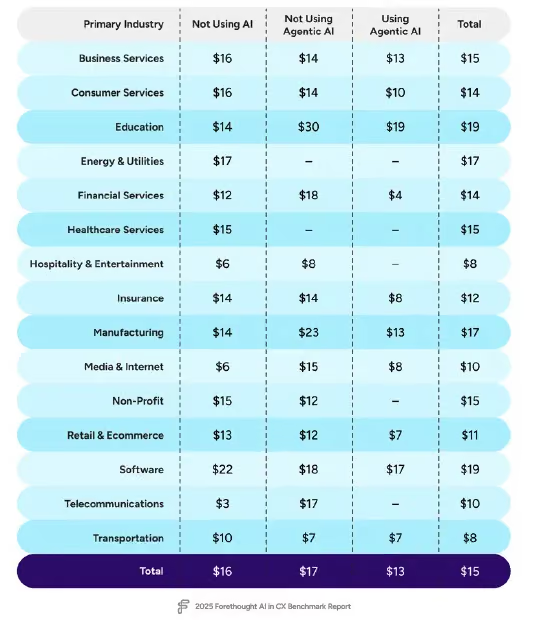
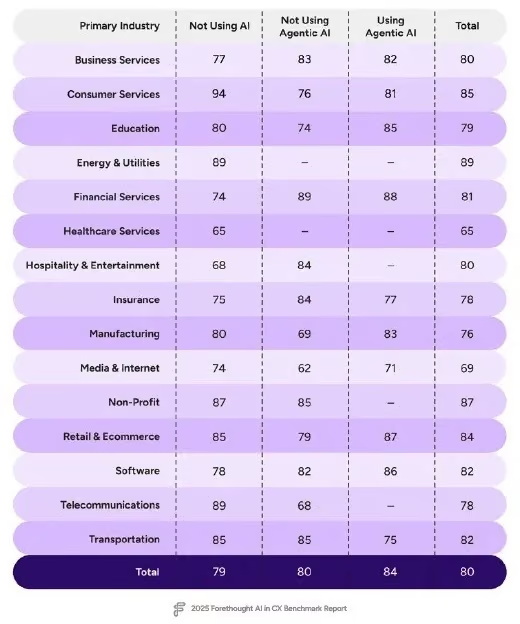
Our recent Forethought 2025 AI in CX Benchmark Report surveyed 642 US-based companies and found that software companies pay an average of $19 per ticket. They’re tied with education for the highest cost per resolution across industries.
That number holds whether companies use AI or not, which tells us something important about why SaaS support is so expensive—the cost comes from the nature of the work itself.
In some industries, tickets are informational. In retail, for example, a retail customer might ask where their order is or what the return policy covers. The answer exists in a database, and providing it resolves the issue. SaaS tickets are usually different. An API integration is failing, a subscription needs to change, or team members can't access a feature. These tickets require context on the customer's specific account, configuration, and history, and they often require actions in your systems to be resolved.
Take a customer who wants to change their subscription tier, for example. AI can explain how tiers work or where to find the settings page, but completing the change means accessing the billing system, confirming the customer's eligibility, updating the invoice, and adjusting their feature access. The customer still needs a human to finish the job. SaaS tickets likely cost more because they need human intervention more often than not.
Early AI Moved the Needle, But There's More Savings to Capture
If you've invested in AI for customer support, you probably deployed some form of generative AI. These systems use large language models to understand customer questions and generate responses based on your knowledge base, help articles, and documentation. They represent a significant leap from the rigid decision trees and keyword-matching chatbots of the past, and they delivered real results.
But generative AI has an architectural ceiling that becomes visible when you look at what these systems can and cannot do. Generative AI might explain your refund policy, but it won’t process the refund. It will describe the steps for resetting a password, but it won’t execute the reset.
For SaaS companies, this ceiling matters more than in other industries because many tickets require action rather than information. When a customer wants to change their subscription tier, modify their account settings, troubleshoot an integration, or provision access for a new team member, the resolution requires changes to your systems. Guiding the customer through documentation only gets you partway there, and the remaining cost is still human labor completing what the AI could not.
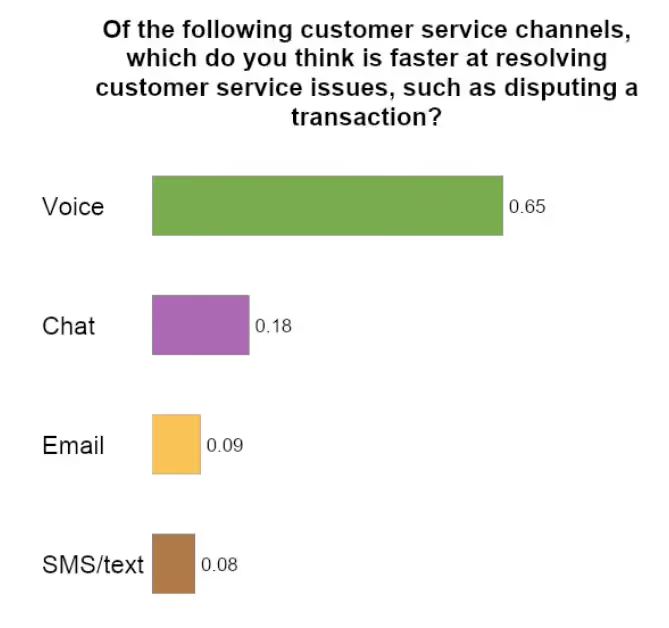
Customers have also noticed this ceiling. After enough interactions where their issue wasn’t resolved, they've adapted. In Forethought's 2025 Voice of Customer research, 60% of consumers said voice is the most effective channel for resolving issues, compared with just 19% who said chat. This is because calls reach humans, who can take action, and issues are resolved.
The chat data tells the same story from a different angle. When asked what matters most in a chat interaction, 33% of consumers ranked "connect me to a human agent" as their top priority, while only 29% ranked "solve my issue" first. Customers have learned that reaching a human is how resolution happens.
The opportunity now is raising that ceiling. Generative AI captures the deflection gains from better answers and faster responses, but agentic AI will capture the cost reductions from completed transactions.
Agentic AI Resolves Tickets by Taking Action
Up to this point, the limiting factor in AI-driven support hasn’t been authority. Most systems can understand a request and explain the next step, but the transaction itself still belongs to a human.
Agentic AI removes this constraint by shifting ownership of the transaction itself. When AI is connected to your systems and permitted to act within defined policies, it can resolve issues. The work that once required a handoff is completed autonomously, and the ticket closes in the same interaction it’s opened.
Forethought was designed from the start to move beyond answer generation and into execution. Today, the platform processes over a billion customer interactions each month using chat agents, email agents, voice agents, and those built for internal channels like Slack.
At the core of that capability is Autoflows, Forethought’s agentic reasoning engine. Autoflows executes step-by-step workflows directly inside your systems—CRM, billing platforms, subscription management tools, authentication services—based on policies you define.
Consider how that changes some common SaaS support interactions:
- If a customer requests a refund, autoflows can check eligibility, process the refund, update records, and send confirmation.
- If a customer needs to change their subscription tier, autoflows can make the change, confirm the new pricing, update the invoice, and adjust feature access.
- When API calls begin failing, autoflows can verify authentication status, review recent error logs, identify the failure point, reset credentials if needed, and confirm the fix.
Because the same agentic logic operates across chat, email, voice, and internal tools like Slack, customers can move between channels without restarting the process.
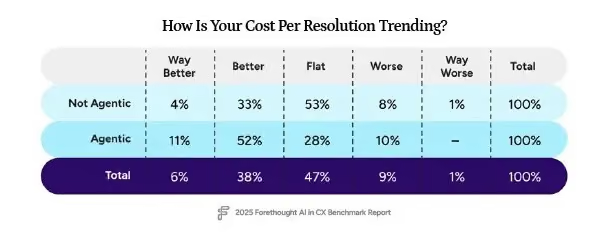
The performance gap between agentic and non-agentic systems is already measurable. Sixty-three percent of companies using agentic AI reported cost per resolution trending better, compared to 37% of those using non-agentic AI.
For B2B and SaaS companies, the impact is even clearer. Organizations using agentic AI report deflection rates 24% higher than peers relying on non-agentic systems. CSAT averages 86, six points higher than non-agentic and twelve points higher than teams with no AI.
When AI completes the transaction, the cost structure changes. Because the ticket never reaches an agent, there is no queue time, no handling time, and no follow-up work required to close the issue.
What remains for human teams to focus on is a smaller, more valuable class of work: edge cases, nuanced judgment calls, and genuinely complex problems that require human expertise. Those tickets cost more by design, and that cost is justified.
Software Companies Are Already Seeing Results
Software companies that succeed with agentic AI don’t usually start by trying to automate everything. They make a small number of deliberate choices about where AI should act, what it’s allowed to change, and how responsibility is shared between systems and humans.
Across the examples below, teams focused on issues that could be fully resolved, gave AI direct access to the systems where support work happens, and designed workflows around closing tickets. The results were fewer tickets reaching agents, higher customer satisfaction, and support teams spending their time on work that actually requires human judgment.
Grammarly reduces cost while also resolving follow-up complexity
Grammarly’s support challenges are typical of large SaaS platforms: issues rarely resolve with a single answer. Users might reach out when the product doesn’t appear on a page, when an integration fails in a specific environment, or when features behave differently depending on context. Conversations evolve as users clarify what they’re seeing, ask follow-up questions, or describe related problems.
This complexity is where Grammarly’s previous chatbot fell apart. It could handle isolated questions, but wasn’t designed to maintain context or adapt to changing conversations. Grammarly adopted Forethought to address that gap.
By connecting Forethought’s Autoflows to internal systems via APIs, Forethought resolved customer issues directly. The AI could interpret intent across multi-turn conversations and take action as needed to resolve issues without handing them off to human agents.
With 87% deflection, most tickets never entered the agent queue, eliminating handling time and follow-up. At the same time, CSAT rose to 4.2, showing that resolution was driving satisfaction. By replacing a brittle, manually maintained chatbot with an agentic system, many customers reduce support cost while preserving the experience SaaS users expect.
ActiveCampaign automated configuration-dependent issues
ActiveCampaign’s support challenges were similarly complex. Users contact support with questions about campaign setup, automation behavior, and CRM workflows, which can’t always be answered in the abstract. Resolution depends on understanding what the customer has built, what they’re trying to accomplish, and where the configuration breaks down.
ActiveCampaign adopted Forethought Autoflows to move beyond rule-based automation. By training the system on internal knowledge and historical support data, and connecting Autoflows to internal tools such as CRMs and help desks, the AI could interpret intent and resolve issues directly, without handing tickets off to agents.
Now with more than 60% deflection, a significant share of tickets never reach an agent, even as the business continues to grow. That reduction translated into fewer tickets handled overall and meaningful weekly time savings.
Across these examples, we see that once agentic AI takes ownership of resolution, support stops scaling linearly with usage. Agentic AI sets the stage for a cost advantage that compounds over time.
The Cost Advantage of Agentic AI Will Only Compound
For as long as SaaS has existed, support costs have scaled with customer growth. More users mean more tickets, more agents, and higher operating expenses. That relationship has been treated as a fixed law of the business model rather than a design choice.
But companies adopting agentic AI are breaking the link between growth and support cost. When AI completes transactions instead of routing them, incremental usage does not automatically create incremental labor. Tickets that never reach an agent don’t add queue time, handling time, or follow-up and those savings persist every quarter they remain in place.
Teams that make the shift aren’t just reducing cost per resolution today; they’re operating on a different cost curve going forward. As both they and their competitors grow, one absorbs support cost linearly while the other does not. The gap widens with each release cycle, each new customer cohort, and each additional channel brought online.
Hashtags blocks for sticky navbar (visible only for admin)
{{resource-cta}}
{{resource-cta-horizontal}}
{{authors-one-in-row}}
{{authors-two-in-row}}
{{download-the-report}}
{{cs-card}}